

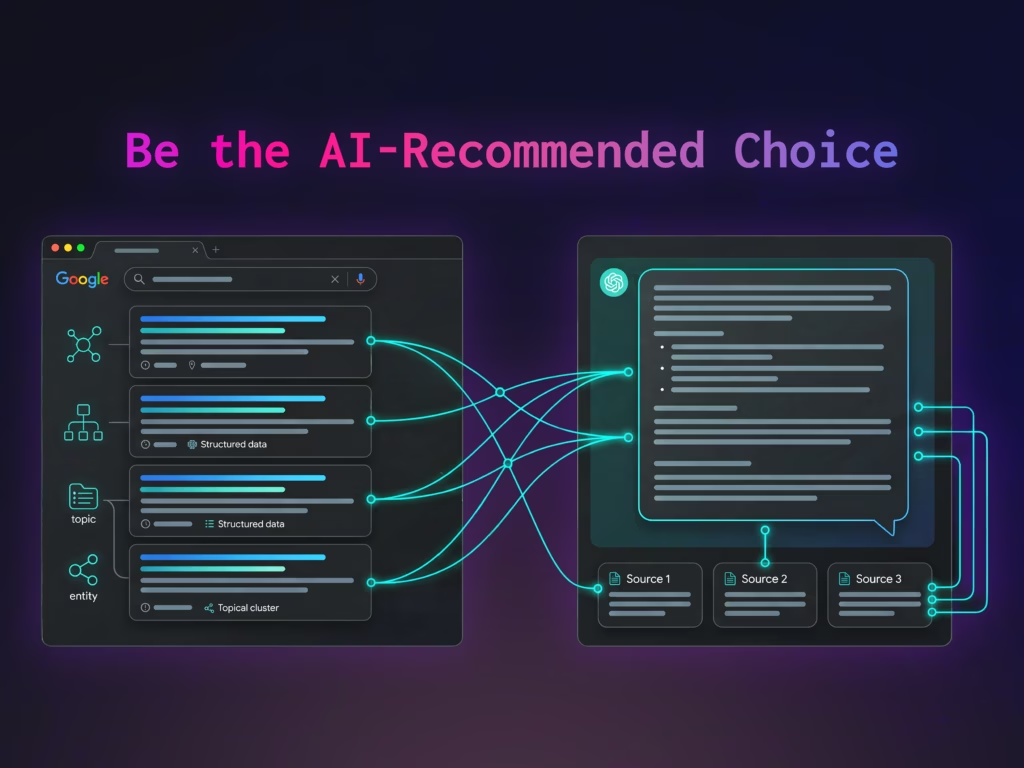
Large language models like ChatGPT, Claude, Perplexity, and Google Gemini are quickly becoming the places where your next clients ask their most important questions.
When someone types “best SEO agency for law firms” into an AI assistant, the brands that get named in the answer—often with a short explanation of why—win the click, the trust, and eventually the lead.
The catch: traditional SEO alone is no longer enough.
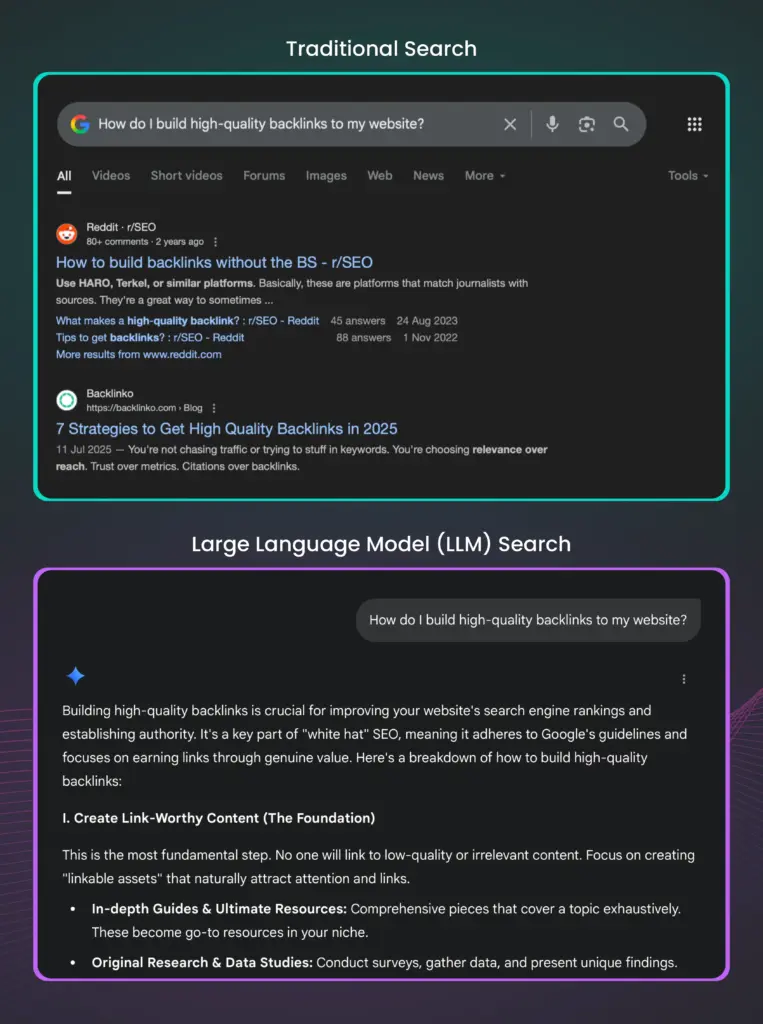
LLMs still use search data, but they don’t simply “lift” the top organic results and reprint them. They interpret the prompt, scan a much deeper slice of the web, and synthesize a single, conversational answer that blends multiple sources and perspectives.
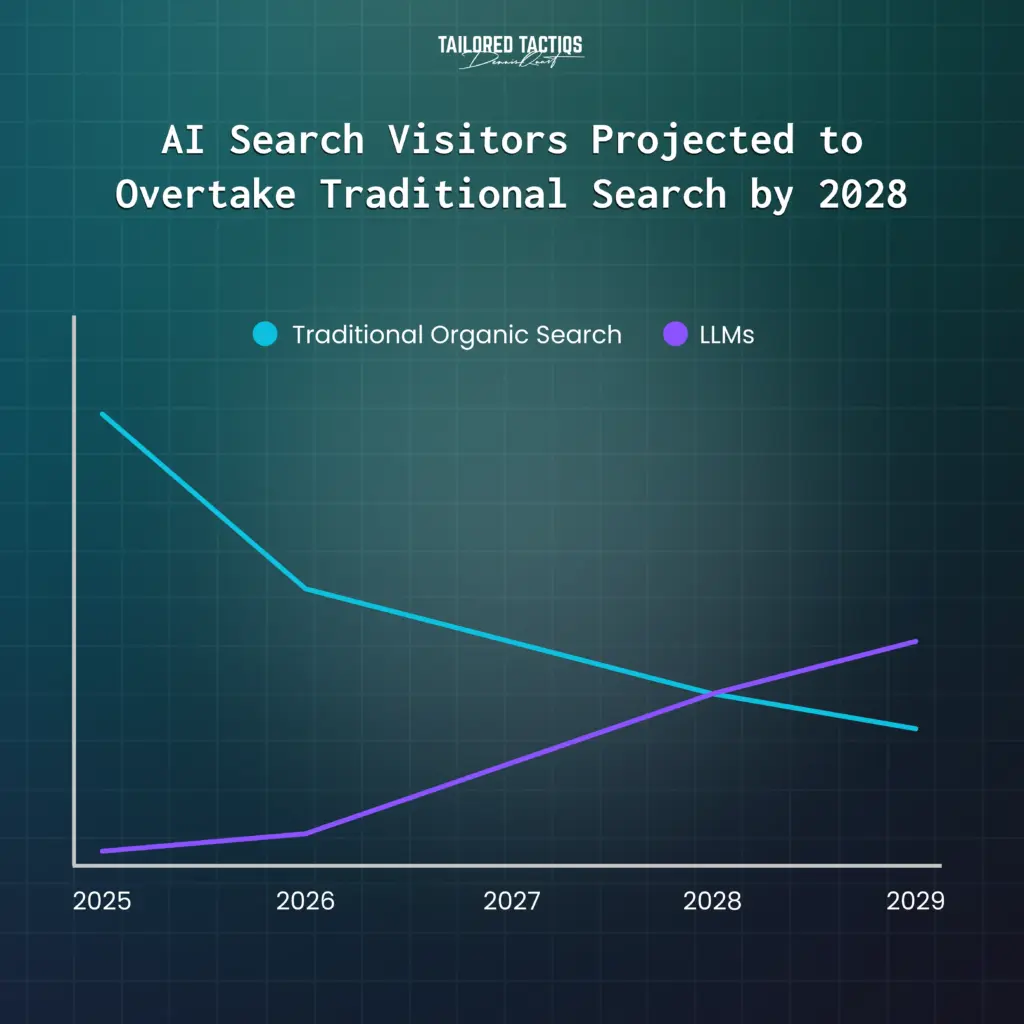
Fresh insights from Semrush highlight the scale of this transformation: LLM-driven traffic is projected to surpass traditional Google search by 2028.
This is where LLM optimization (LLMO), sometimes called Generative Engine Optimization (GEO), comes in.
Instead of optimizing just for rankings, you’re optimizing so that AI systems can discover your content, trust it, and choose your brand as part of their answer.
Think of it as an evolution of SEO rather than a replacement: you still need crawlable, high‑quality pages, but you also need LLM‑ready structure, schema, and brand signals that make your content easy to reuse in AI responses.
This guide is written for small businesses, in‑house marketers, and lean agencies that want to turn AI answers into real‑world visibility and leads—without hiring a data science team or rebuilding their tech stack from scratch.
- How AI search works (prompt → retrieval → synthesis) and what that means for your SEO decisions in 2026.
- Spot early signs that your LLM visibility is increasing—even if your Google traffic looks flat or slightly down.
- Structure pages, FAQs, and tables so they’re easy for LLMs to quote—while still reading naturally for humans.
- Seven strategies tailored to small businesses to build topical authority, strengthen your entity signals, and grow AI‑driven brand mentions.
Why LLMs Are Changing SEO
LLMs are advanced AI systems trained on massive datasets of text and code, capable of generating human‑like, context‑aware responses to almost any prompt.
In practice, they act like a hybrid of a search engine, a researcher, and a copywriter: they look up information, connect the dots, and then respond in clear, conversational language.
Traditional SEO was built around rankings and clicks: appear as high as possible in the SERP, earn the click, then convince the visitor to stay.
LLM‑driven AI search adds a new layer: the answer itself is generated on the fly, and your brand may be mentioned, cited, or completely bypassed, even if you are ranking for the underlying query.
How AI Search Actually Works in 3 Steps
Behind the scenes, most AI search experiences follow a similar three‑step workflow:
- Understanding the Prompt
The model interprets what the user is really asking, often expanding the query into several related sub‑prompts (“best SEO agency” becomes variations like “SEO for law firms,” “SEO services pricing,” and “how to choose an SEO partner”). - Retrieval
The AI system then fetches information in real time from one or more indexes—search engine results, curated databases, documentation, and sometimes your own site if it’s part of a connected knowledge base. Unlike classic SEO, this retrieval step often looks far beyond the first page of results and into long‑tail, niche pages that provide specific, trustworthy answers. - Synthesis
Finally, the model chooses which pieces to use and stitches them together into a single answer. At this point, factors like topical authority, content structure, freshness, and entity trust (how well the AI “knows” your brand) heavily influence whether your site is cited or your brand is named.
What changes for you?
- You still want to rank well, but ranking is no longer the finish line—it’s just your entry ticket into the retrieval pool.
- Content that’s clearly structured, deeply helpful, and easy to quote has a much higher chance of being pulled into answers.
- Your broader web presence (schema, directories, third‑party coverage, community mentions) now matters as much as on‑page SEO, because it builds the entity‑level trust LLMs rely on.
In short: Unlike traditional search engines that prioritise keyword rankings and backlinks, LLMs focus on semantic relevance, topical authority, and trustworthiness.
The New Reality: AI Overviews and Deeper Sourcing
AI-driven search is becoming increasingly popular, particularly among Millennials and Gen Z.
Google’s AI Overview, one of the first integrations of large language models into a traditional search engine, is projected to reach 1.5 billion monthly users.
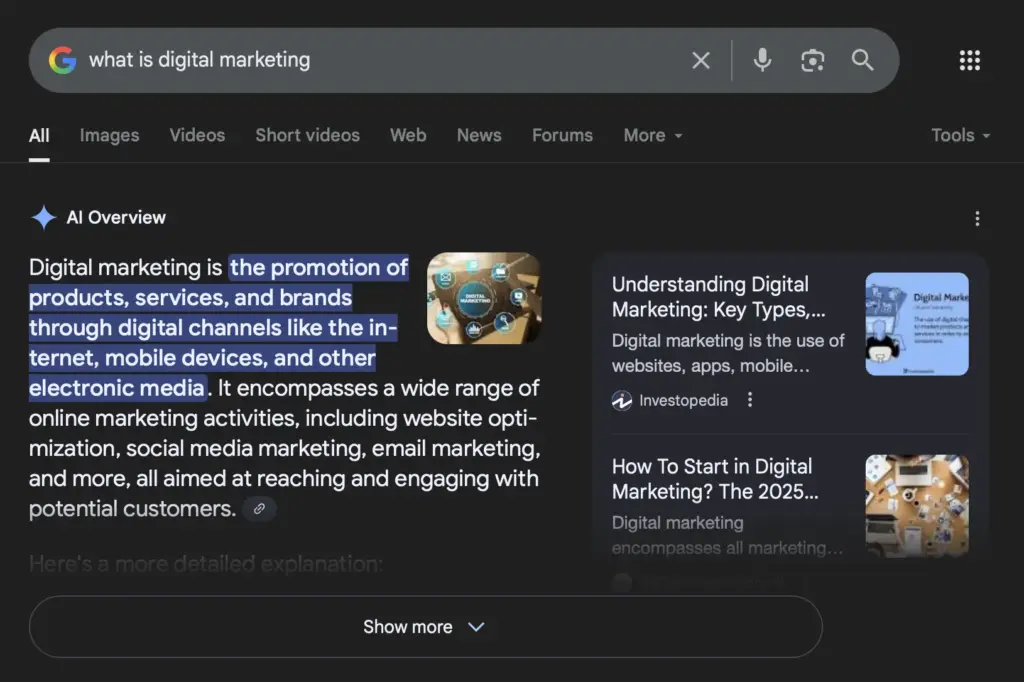
These AI-generated summaries, displayed above traditional search results, provide conversational, source-cited answers, altering the search experience and creating a zero-click environment where users get immediate answers without visiting websites.
Google’s AI Mode, on the other hand, the latest integration in the Google search engine, blends traditional and AI search, allowing users to switch modes, but visibility now hinges on optimizing for AI citations, not just clicks.
Where LLMs Get Their Answers (Hint: It’s Not the Top 5)
According to Semrush’s large‑scale AI search study, nearly 90% of ChatGPT’s citations come from pages ranked beyond position 20 in traditional Google results. In other words, AI tools are willing to skip over the usual “top 10” to find content that better fits the user’s question.
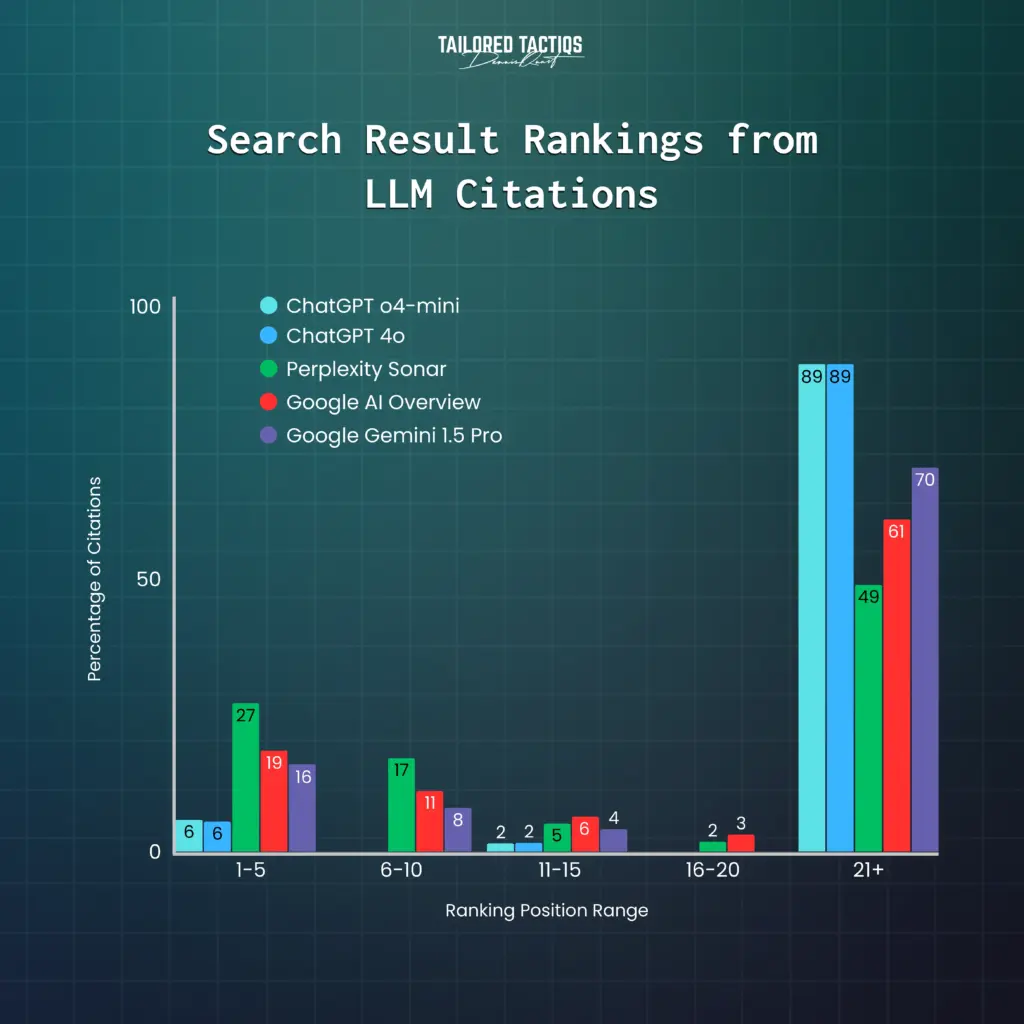
That’s good news for smaller brands and specialists.
A carefully structured guide on “SEO for Vancouver family law firms” can be cited even if it sits on page two or three of Google, because it answers a highly specific question better than generic SEO content targeting broad terms.
The “Citation Core” and Entity Trust
In most industries, a small group of sites become what can be called the citation core: domains that show up again and again across AI tools because they consistently provide trusted, structured, and well‑maintained information.
Think of Wikipedia for general topics or niche industry directories for specialized queries.
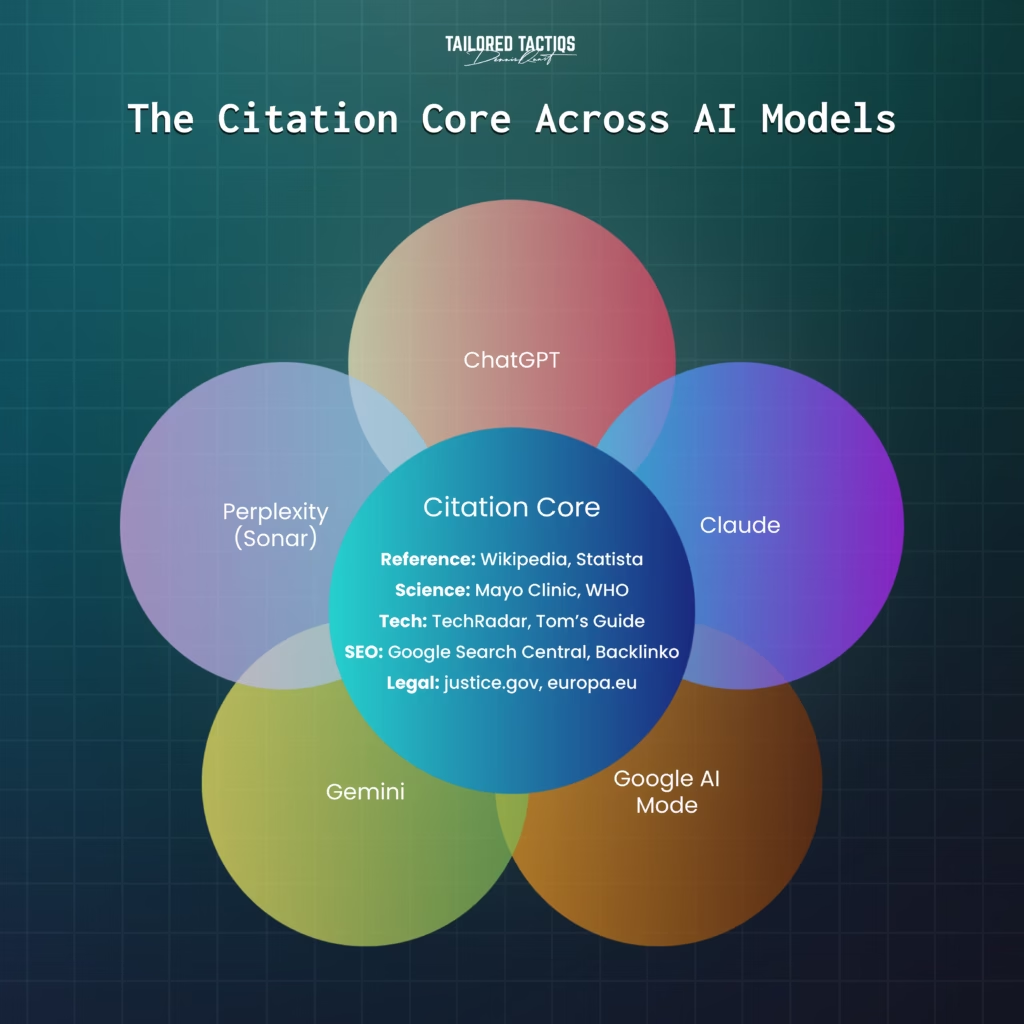
To move your brand closer to this inner circle in your space, LLMs look for a combination of signals:
- Strong topical authority on your site: clearly organized clusters of content around your core themes.
- Clean organization and article schema that unambiguously identify you as the source and author.
- Consistent presence in authoritative directories, review sites, and industry publications where your brand appears alongside other trusted entities.
- Real‑world conversations about your brand across forums, Q&A sites, and social platforms that LLMs ingest as training data.
Different AI platforms weigh these ingredients differently. For example, some lean more heavily on community discussions, while others prefer fresher, editorially reviewed sources or their own search index.
That’s why your LLM optimization efforts should mix on‑site improvements with off‑site and community signals rather than focusing on a single channel.
Signs Your LLM Visibility Is Increasing
Your analytics may suggest declining traffic, but your brand influence could be soaring.
For example, one of our clients’ organic search clicks dropped 15% while impressions rose 54% over three months, indicating users see content in AI responses and search directly later.
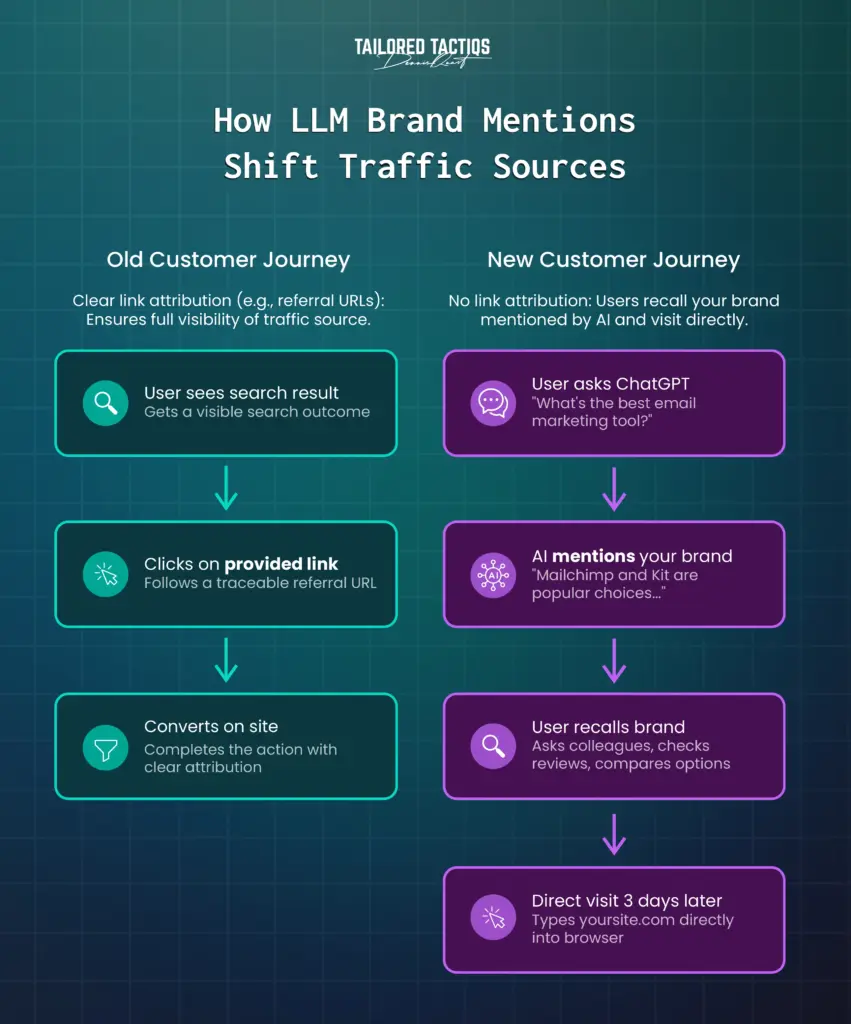
Here are three signs of growing LLM visibility:
- Reduced organic traffic with consistent branded search volume: People are finding your brand through AI interactions and later searching for you directly (showing as direct traffic in Google Analytics).
- Prospects mentioning AI as their discovery source: Customers referencing AI tools during inquiries provide clear evidence of LLM-driven exposure.
- Competitors with weaker traditional SEO outperforming: They’re likely capitalizing on AI-driven visibility, even if their search rankings lag.
The Challenges of LLM Optimization
Optimizing for LLMs is not about chasing a new set of “AI hacks.” It’s about adapting familiar SEO fundamentals to a world where answers are probabilistic, multi‑sourced, and increasingly zero‑click.
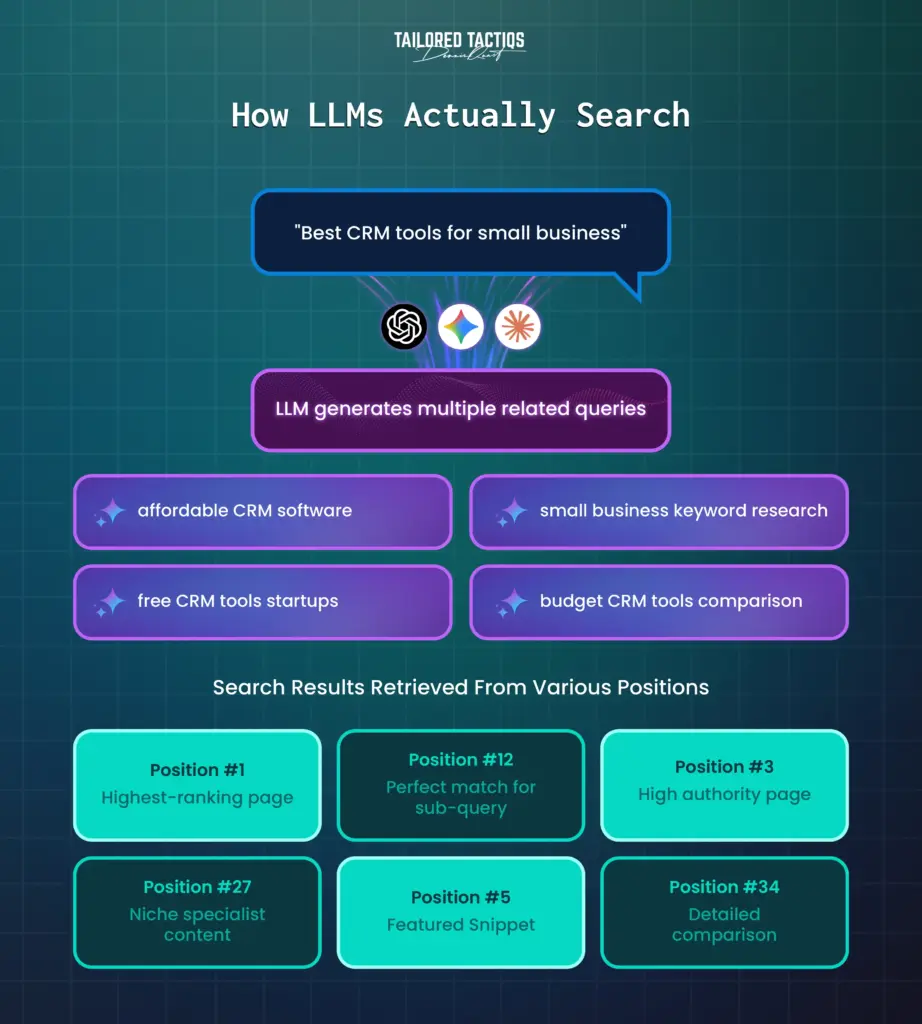
Each of the challenges below maps directly to at least one of the seven strategies covered later in this guide.
- Probabilistic Responses: LLM answers can change based on subtle prompt differences, conversation history, or the user’s follow‑up questions. That makes your visibility less deterministic than a fixed ranking position. The best defense is topical depth and question‑shaped content: the more angles and sub‑questions your site covers clearly, the more opportunities the model has to pull you in.
- Zero-Click Search: AI Overviews and chat‑style interfaces often satisfy the user without a click, which means your win condition shifts from “session” to “mention.” You want your brand name, your unique data, and your offers embedded in the fragments AI reuses, supported by strong schema and context‑inclusive copy.
- Data Limitations: Some LLMs like Claude rely on static data with a knowledge cut-off date, which limits their ability to provide up-to-date information. But AI search engines with real-time retrieval capabilities can overcome these limitations by providing the most current data and ensuring users get up-to-date information.
- Quality Over Quantity: LLMs prioritize in-depth, trustworthy content over keyword-stuffed pages, in line with Google’s E-E-A-T (Experience, Expertise, Authoritativeness, Trustworthiness) principles. Sourcing information from reputable sources is essential to ensure the trustworthiness and authority of your content.
- Domain Consistency: Inconsistent brand names, missing organization schema, or scattered directory profiles make it harder for LLMs to recognize you as one coherent entity. Tightening your entity footprint—on your own site and across the web—directly improves your chances of being included when AI answers questions in your niche.
How to Optimize for LLMs: 7 Strategies for Small Businesses
To rank in LLM responses, focus on discoverability, authority, and user-centric content. Gaining LLM visibility is a two-step process: Discovery and Citing.
First, an LLM must be able to find your content through its training data or real-time search queries. Second, your content must be deemed credible, specific, and helpful enough to be used as a source in the generated response.
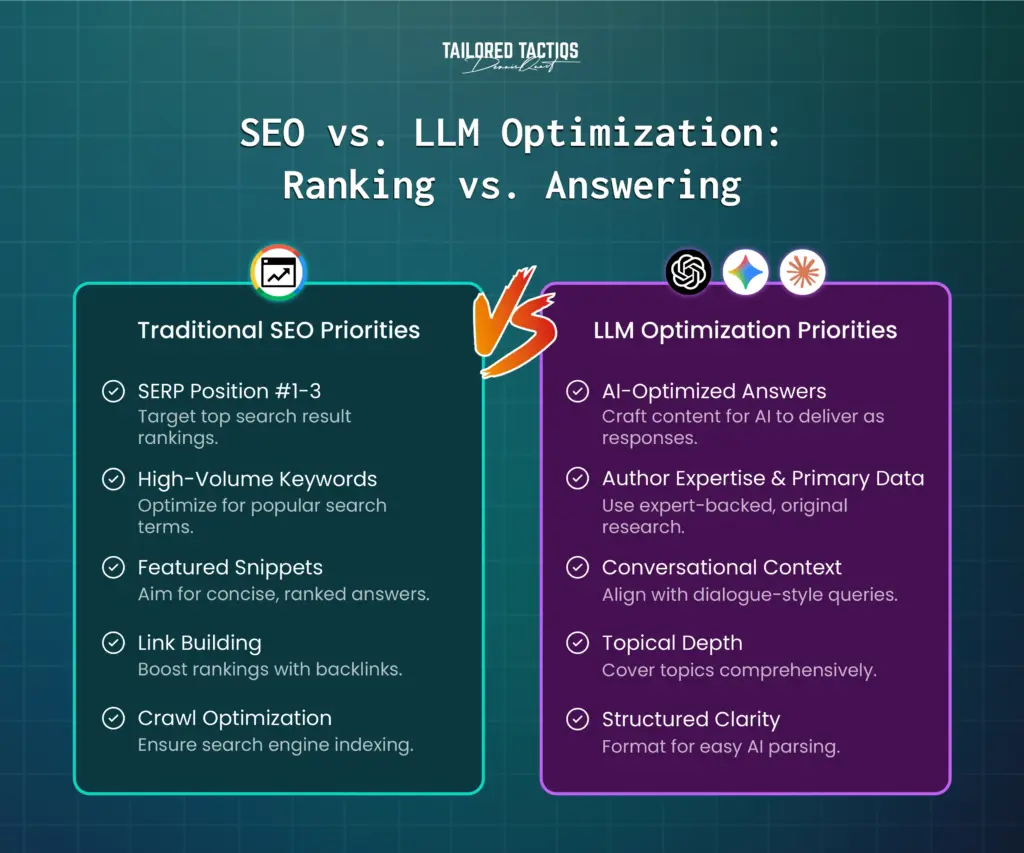
Structuring and guiding your web content for LLM platforms is critical for better performance in generative search and inclusion in AI-generated answers.

Ultimately, building brand visibility and driving LLM traffic are the goals of optimizing for large language models and AI search engines with the aim of providing authoritative answers that are included in AI-generated responses.
Drawing from industry research and expert analysis, here are seven practical strategies:
1. Build Topical Authority
LLMs favor brands that look like genuine experts on a subject, not just sites with one or two strong pages.
For a small business, that means choosing a few profitable topics and covering them end‑to‑end with tightly linked, clearly structured content.
For example, a digital marketing site could have a hub page on “SEO Strategies” with subpages on on-page SEO, link building, and content optimization.
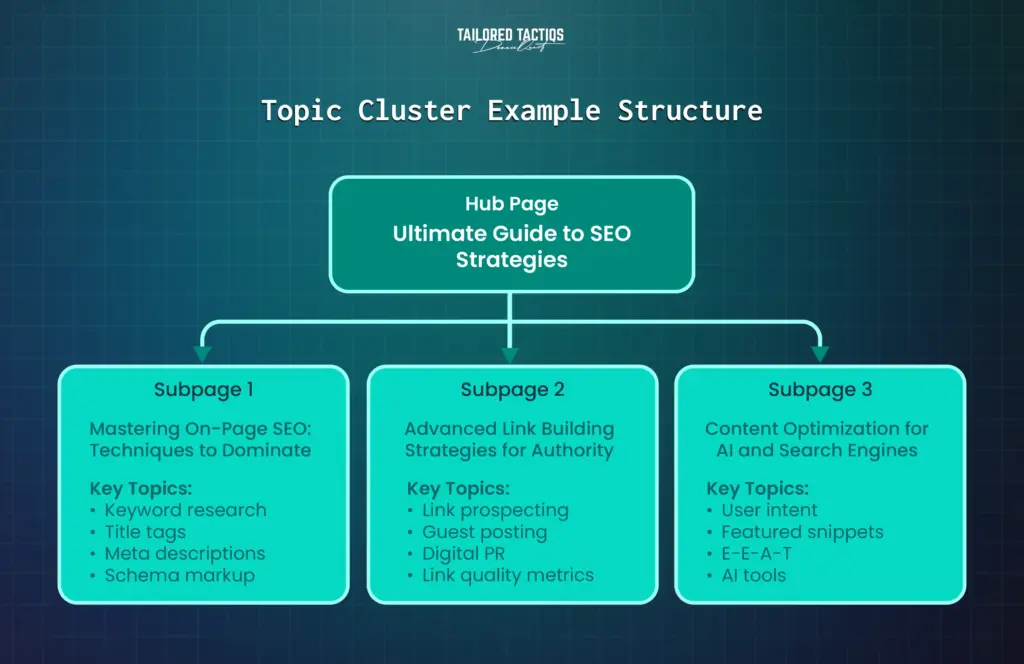
A 2024 study cited by Surfer found that well-organized, comprehensive content increased AI response inclusion by up to 37%.
Within your topic clusters, don’t be afraid to get granular. LLMs excel at finding the single best answer to a very specific question.
For example, a general page on “SEO” is less likely to be cited than a detailed guide on “How to disavow toxic backlinks after a manual penalty in 2026.” The more specific and in-depth your content is, the higher its utility for an LLM looking to answer a precise query.
Every cluster page should:
- Start with an answer‑first paragraph: 40–60 words that clearly answer the main question in plain language.
- Follow with 3–5 H2s that mirror common prompts (e.g., “How much does…” “How long does…” “What are my options if…”).
- End with a short FAQ block (3–5 questions) marked up with FAQ schema so AI systems can quickly find and reuse your key answers.
Repeat this “example + role split + pattern” structure for the remaining six strategies to keep the section highly actionable and skimmable.
Action Step: Use Surfer’s Topic Map or Semrush's Keyword Gap Tool to identify content gaps. Create or update 3-5 in-depth guides to establish topical authority.
2. Write Conversational, Question-Focused Content
LLMs love conversational questions like “How do I improve my website’s SEO in 2026?” Write content in natural language, using Q&A formats, clear subheadings, and concise answers.
For example, Tailored Tactiqs’ post on “How to Build a Powerful Brand Identity for Small Business Success” uses subheadings like “What Is a Brand Identity?” to match user intent.
Include FAQs to capture quick, AI-parsable answers.
AI chatbots and LLM platforms use this conversational content to generate quick, context-rich answers and enable users to ask follow-up questions for deeper engagement and clarification.
Action Step: Use AnswerThePublic or Google’s “People Also Ask” to find conversational questions.
3. Conduct LLM Seeding
LLM seeding means creating content in formats and locations LLMs will cite, such as FAQ pages, structured lists, or tables.
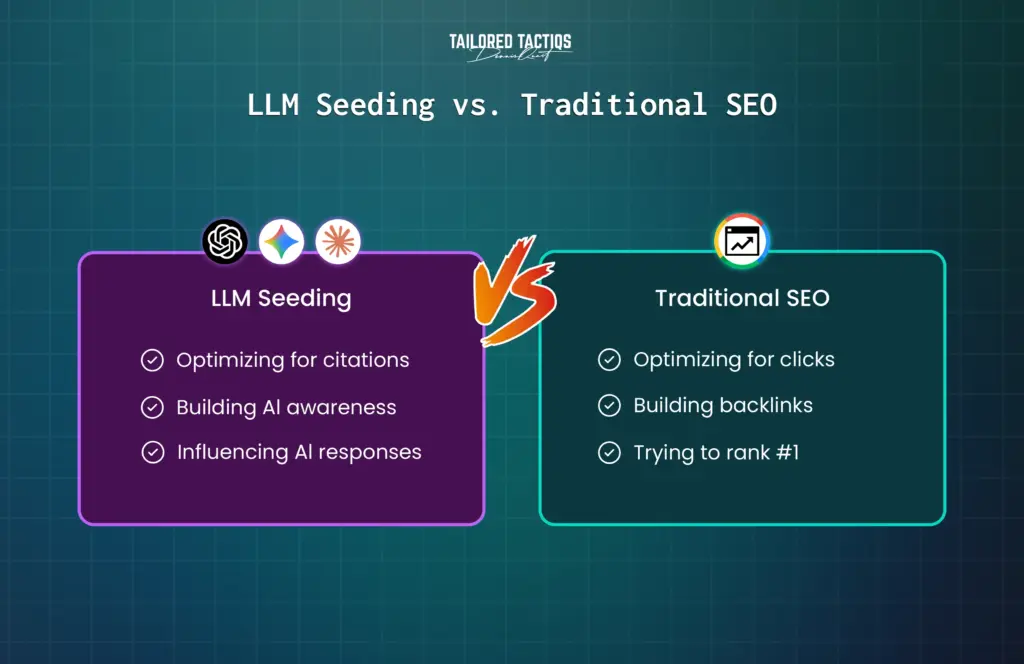
Structured formats like lists and tables exist to make it easier for AI systems to parse and cite content, as more users are searching through AI-powered tools rather than traditional search engines.
For example, a post titled “Best SEO Tools for Small Businesses” with bullet-pointed answers and schema markup (e.g., FAQPage or HowTo) is easily parsed by AI.
Surfer’s study of 400,000+ searches showed that structured formats like lists and tables boost AI inclusion rates, further increasing your brand’s LLM visibility with AI-powered search platforms.
Action Step: Create 3-5 FAQ style posts with structured data. Use Schema.org to add relevant markup to your pages.
4. Technical Accessibility
AI crawlers like OpenAI’s GPTBot, Google’s Googlebot, and the newer Google-Extended rely on accessible HTML content. Google-Extended is a specific user-agent that Google uses to gather data to train its generative models, so ensuring it has access is crucial. Make sure your robots.txt file is not blocking these essential bots.
One file you can stop worrying about is llms.txt. It’s a proposed standard meant to give AI systems a curated map of your most important pages. It sounds tailor‑made for this, but Google has confirmed it ignores the file, and independent log studies show AI crawlers almost never request it. If your SEO plugin generates one automatically, there’s no harm in keeping it, but avoid publishing indexable Markdown copies of every page, as this can create duplicate content at scale.
Since AI prioritizes raw HTML, don’t hide critical content in JavaScript, images, or videos. Include descriptive alt text for images and transcripts for videos. A clear site hierarchy with descriptive internal links will also help AI understand your content’s importance.
Action Step: Check your robots.txt file and submit sitemaps to Bing Webmaster Tools and Google Search Console. Use Screaming Frog to ensure content is HTML accessible.
5. Implement AI-Enhanced Schema Markup
Schema helps AI understand your content’s context. Use Organization schema to define your brand’s name, logo, and social profiles, and Article schema for blog posts to highlight publication dates and authors.
Google’s documentation states schema powers AI Overviews and rich results.
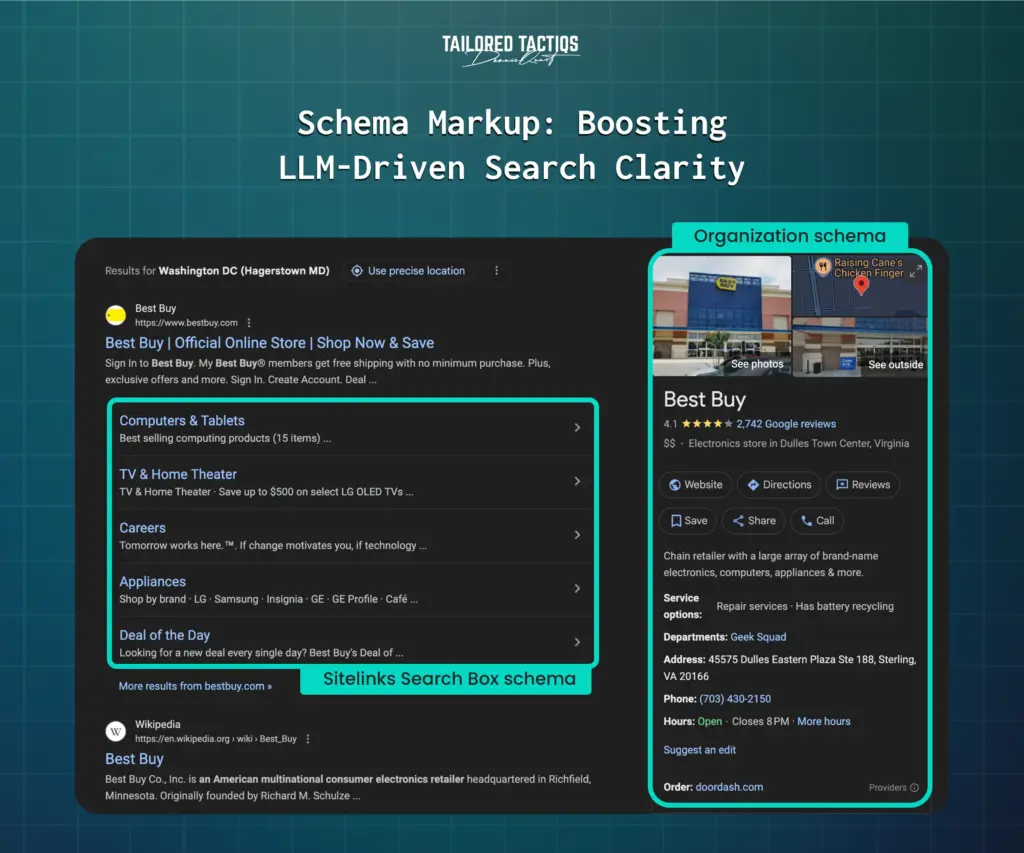
Proper schema helps AI generate direct, authoritative answers from your content by making it easier to interpret and extract relevant information. Not a guarantee but schema increases your chances of being cited.
Action Step: Implement Organization and Article schema using a Schema Markup Generator. Validate with Google’s Rich Results Test.
6. Build Brand Authority and Become a “Known Entity”
LLMs build trust based on your brand’s overall prominence and recognition. Think of it as building a “resume” for your brand on the web. Your goal is to become a “Known Entity” that an LLM has encountered many times in trusted contexts.
To do this, get your brand cited in high-authority sources like Wikipedia, Wikidata, or industry directories (e.g., Google Business Profile, Yelp, CrunchBase).
More resources: In our article "Local SEO Strategies: How to Outrank 99% of Local Businesses on Google," you can get more information on how to outrank your competitors.
Backlinks from respected sites and mentions in “best of” lists (e.g., “Top 10 SEO Blogs of 2026”) are gold for LLM visibility.
Proactively pitch to journalists via HARO or Qwoted for expert quotes, as we’ve done at Tailored Tactiqs to get mentioned in marketing publications.
To amplify your chances of being cited alongside competitors, focus on strategic co-citation. Research shows top-cited businesses appear in “expert clusters” where publications discuss best practices and reference multiple authorities.
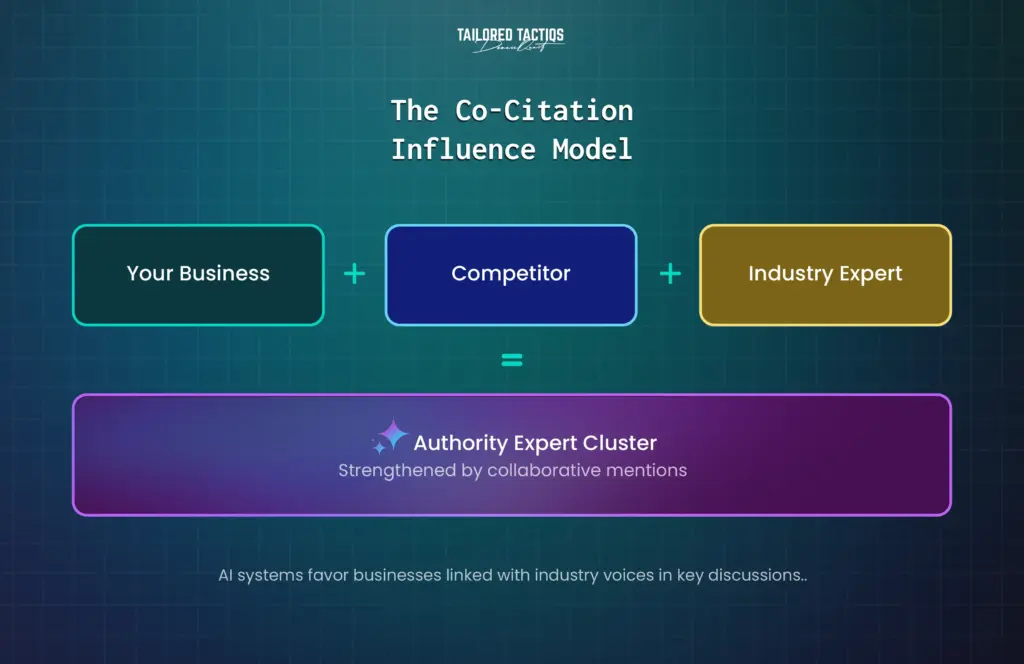
To join these conversations, guest post on publications that cite your competitors, contribute valuable insights to expert roundups, or comment thoughtfully on high-authority industry content.
To further increase authority in AI-generated responses, focus on increasing brand visibility and including original data like unique research, statistics, or case studies in your content.
Action Step: Create a list of 5-10 industry directories or publications for citations and co-citation opportunities. Prioritize platforms where your competitors are already mentioned to maximize your visibility in expert clusters.
7. Engage in Relevant Online Communities
LLMs are trained on vast datasets that include public forums and community platforms like Reddit, Quora, and industry-specific forums.
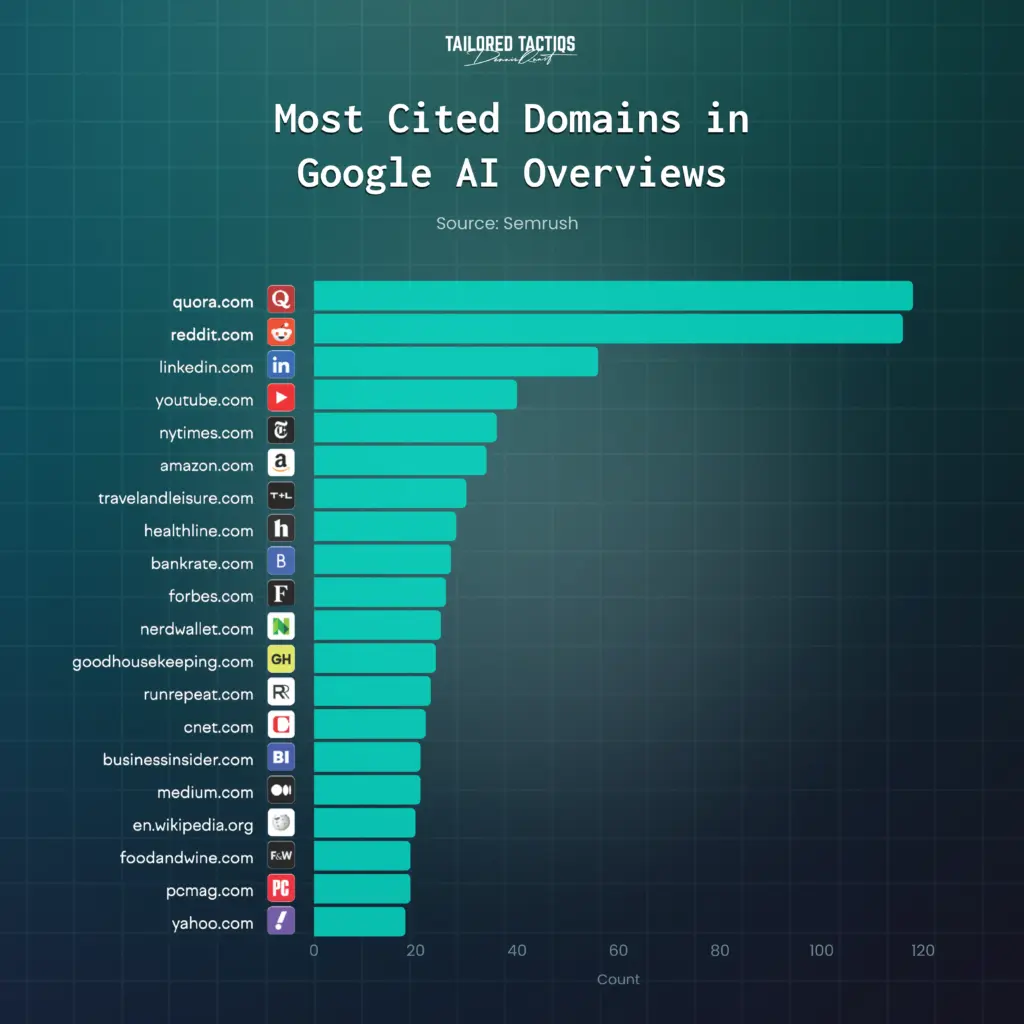
Having your business, products, or experts mentioned positively in these real-world conversations provides powerful social proof and context.
These platforms are where nuanced problems are solved, and authentic experiences are shared—signals that are invaluable to an LLM trying to determine expertise (E−E−A−T).
Action Step: Identify the top 3-5 subreddits or online forums where your target audience asks questions. Participate genuinely by offering helpful advice. When appropriate, you can mention your brand or link to a relevant piece of content on your site.
Programmatic SEO: Amplifying LLM Visibility
Programmatic SEO is about creating many highly targeted pages from a single template and a structured data source, then keeping them fresh over time.
In an LLM context, it’s a way to cover long‑tail combinations (“service × location,” “problem × audience”) that AI tools love to surface in niche recommendations. For example, Wise’s 8.5 million currency converter pages use templates with unique, user-focused data.
A Simple Workflow For Small Teams
- Pick one pattern
Choose a combination that maps directly to how your buyers search. For example:- “[Practice area] lawyer in [city]” for a regional law firm.
- “[Service] for [industry] nonprofits” for a specialist agency.
- Design an LLM‑ready template
Your page template should include:- Answer‑first intro paragraph tailored to the location/industry.
- 3–4 H2s covering who it’s for, what’s included, pricing/expectations, and next steps.
- A short local or sector‑specific case example.
- A 3–5 question FAQ block specific to that combination.
- Connect your data
Use a spreadsheet or CMS fields to store the variable pieces (city names, industries, unique benefits). Connect this to your CMS or a no‑code tool that can generate the pages. - Add schema and internal links
Ensure each page has Service or LocalBusiness schema as appropriate, plus FAQ schema for the Q&A block. Link pages back to your main service pillar and to nearby locations or similar industries. - Review and refine
Start with a small batch (e.g., 10–20 pages), manually review them for quality and uniqueness, and only then scale up. Monitor which pages get impressions, clicks, and AI mentions, and improve those templates first.
This approach lets a small team create a deep lattice of specific, LLM‑friendly pages without writing each one from scratch, while keeping enough control to avoid thin or duplicate content.
Action Step: Identify a programmatic opportunity (e.g., location-based pages). Use a CMS like WordPress with SEOmatic to automate page creation, ensuring each page is unique and valuable.
Measuring LLM Success
Measuring LLM visibility is tough since AI responses don’t drive clicks. Instead, monitor brand mentions in AI outputs using AI Trackers, which analyze mentions across popular LLMs.
Test queries like “Best [Your Niche] Blogs” on ChatGPT or Google’s AI Overviews monthly to see your visibility.
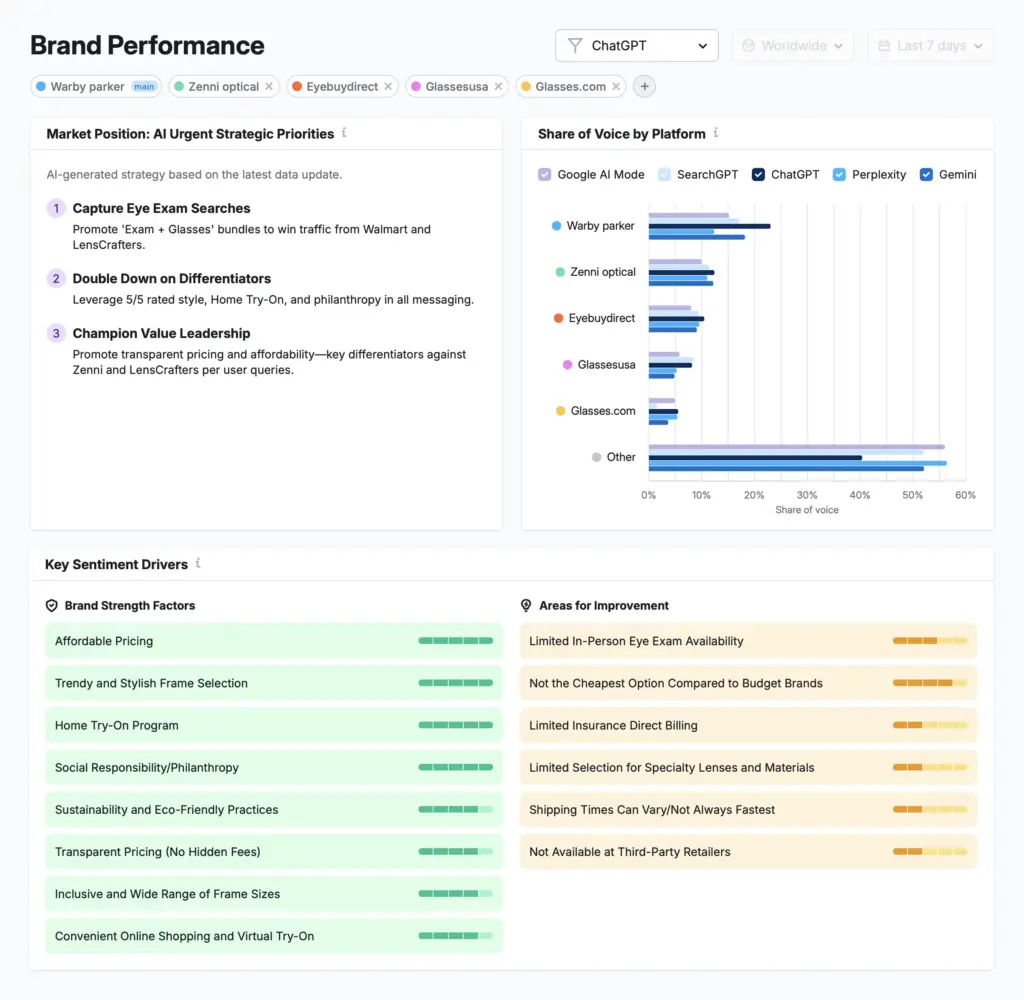
Regularly monitoring content performance in AI search environments is key to adapting and staying relevant. While direct AI mention tracking is essential, don’t neglect traditional SEO metrics.
Since AI Overviews and other RAG systems use real-time search to find information, your content’s ranking on Google is a strong leading indicator of its potential for LLM visibility. If you rank in the top 5 for a key term, you are in the “consideration set” to be cited by the AI.
Therefore, continue to track your keyword rankings, organic traffic, and backlink profile as indirect measures of your LLMO success.
Action Step: Set up an AI tracker, such as Semrush's AI toolkit, or manually test 5-10 industry queries monthly. Adjust content based on citation frequency and sentiment.
Leveling the Field: LLM Optimization Enhances Your SEO Base
LLMs are not replacing traditional SEO but adding a layer on top. As AI search grows, brands that optimize for both traditional and AI search will win.
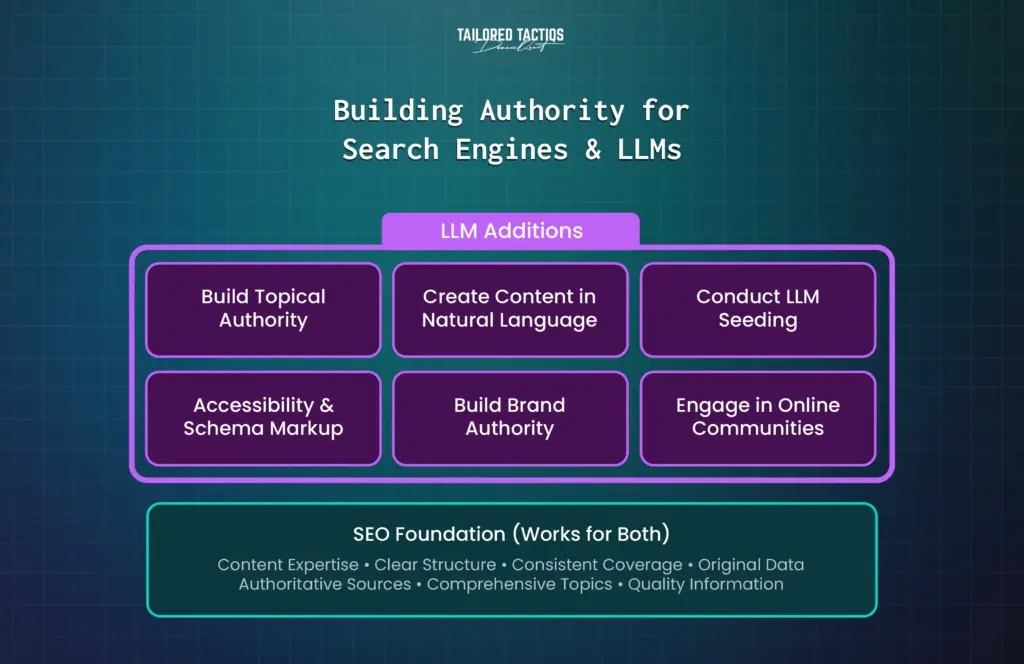
By building topical authority, writing conversational content, LLM seeding, technical accessibility, schema markup, and brand mentions, you can position your website for success.
In short: Optimizing for LLMs is about doubling down on creating genuinely helpful content. The strategies that work for AI are the same ones that have always worked for people: providing clear, satisfying answers, demonstrating first-hand experience, and writing for your audience, not for an algorithm.
LLMs are simply a new, more sophisticated audience that is better at recognizing and rewarding content that is truly helpful.
At Tailored Tactiqs, our Advanced SEO & AI Authority Component is designed to elevate your business’s presence in the age of AI.
We audit your content for relevance and freshness, implement cutting-edge strategies to boost discoverability, and monitor your AI-driven performance.
Ready to boost your LLM visibility? Partner with us today.




 English
  German